Eurovision Song Contest Episode Rating Graph
May 1956 - present

May 1956 - present
7.4

| E1 | E2 | E3 | |
|---|---|---|---|
| S1 | |||
| S2 | |||
| S3 | |||
| S4 | |||
| S5 | |||
| S6 | |||
| S7 | |||
| S8 | |||
| S9 | |||
| S10 | |||
| S11 | |||
| S12 | |||
| S13 | |||
| S14 | |||
| S15 | |||
| S16 | |||
| S17 | |||
| S18 | |||
| S19 | |||
| S20 | |||
| S21 | |||
| S22 | |||
| S23 | |||
| S24 | |||
| S25 | |||
| S26 | |||
| S27 | |||
| S28 | |||
| S29 | |||
| S30 | |||
| S31 | |||
| S32 | |||
| S33 | |||
| S34 | |||
| S35 | |||
| S36 | |||
| S37 | |||
| S38 | |||
| S39 | |||
| S40 | |||
| S41 | |||
| S42 | |||
| S43 | |||
| S44 | |||
| S45 | |||
| S46 | |||
| S47 | |||
| S48 | |||
| S49 | |||
| S50 | |||
| S51 | |||
| S52 | |||
| S53 | |||
| S54 | |||
| S55 | |||
| S56 | |||
| S57 | |||
| S58 | |||
| S59 | |||
| S60 | |||
| S61 | |||
| S62 | |||
| S63 | |||
| S64 | |||
| S65 | |||
| S66 | |||
| S67 | |||
| S68 | |||
| S69 | |||
| S70 |
Browse episode ratings trends for Eurovision Song Contest. Simply click on the interactive rating graph to explore the best and worst of Eurovision Song Contest's 110 episodes.

S65 Ep3
7.8
22nd May 2021
Following the cancellation of the 2020 contest due to the COVID-19 crisis, the Eurovision Song Contest returned in 2021, hosted in Rotterdam. Extensive preparations ensured the show went on with a limited audience and contingency plans, such as pre-recorded 'Live-on-Tape' performances for all artists. These measures were put to the test. Australia, unable to travel, was the only country to use its taped performance. Iceland's rehearsal footage was used for their live show appearances after a delegation member tested positive for COVID-19; the group still finished in 4th place. Italian alt-rock band Måneskin won with their song 'Zitti E Buoni', which became a global streaming hit. The contest's return was a huge success, attracting 183 million viewers and achieving massive online engagement, particularly with younger audiences. The slogan from the cancelled 2020 event, #OpenUp, was carried over.

S67 Ep1
7.3
9th May 2023
The First Semi-Final opened with host Julia Sanina performing part of 'Маяк' by her band, The Hardkiss. The interval featured global superstar Rita Ora, who delivered a medley of some of her biggest hits and her then-new single, 'Praising You'. Ukrainian singer Alyosha, who represented Ukraine at the 2010 Eurovision Song Contest, performed alongside Liverpool's acclaimed singer-songwriter, Rebecca Ferguson. Alyosha, who was forced to leave her country as a refugee in 2022, shared her personal journey through a new, haunting arrangement of Duran Duran’s song, 'Ordinary World'.

S67 Ep3
7.1
13th May 2023
The 67th Eurovision Song Contest took place in Liverpool, where the BBC hosted on behalf of Ukraine under the slogan 'United By Music'. The event expressed solidarity with Ukraine, culminating in an emotional performance of 'You'll Never Walk Alone'. Sweden's Loreen became the first woman to win the contest twice with her song 'Tattoo'. In second place, Finland's Käärijä won the public vote with 'Cha Cha Cha', while Noa Kirel of Israel finished third. Hosted by a team including Alesha Dixon, Graham Norton, and Hannah Waddingham, the Grand Final opened with a performance from 2022 winners Kalush Orchestra. The flag parade featured iconic past Ukrainian contestants, and interval acts included the UK's Sam Ryder and 'The Liverpool Songbook'—a tribute featuring past Eurovision stars like Mahmood, Netta, and Duncan Laurence.

S67 Ep2
7.0
11th May 2023
In the Second Semi-Final, the theme “Music Unites Generations” explored the connection between Ukrainian generations and their music. Mariya Yaremchuk, who represented Ukraine in 2014, led a montage of some of the country's most well-known musical pieces. The performance travelled through time and ended with a collaborative performance from rapper OTOY, 14-year-old Junior Eurovision representative Zlata Dziunka, and Mariya, showing that music is the light that overcomes darkness. Another interval act, a performance called “Be Who You Wanna Be”, celebrated how Eurovision was a place for everyone. Three extraordinary drag performers led a high-energy pop routine with a troupe of dancers. They represented the huge spectrum of fans—regardless of age, nationality, or background—who revelled in being part of the contest. The medley of songs and incredible staging made it a performance to be remembered.

S68 Ep1
6.8
7th May 2024
Fifteen acts will perform at the first semi-final of Eurovision 2024 - but only 10 will qualify.
S58 Ep3
6.8
18th May 2013
Thirteen years after Stockholm hosted the Eurovision Song Contest, the 2013 contest took place in the Malmö Arena in Malmö, Sweden. Two Semi-Finals determined which twenty countries — ten from each Semi-Final — would join the 'Big Five' (France, Germany, Italy, Spain and the UK) and host coumntry Sweden in the Grand Final. The opening act of the Grand Final featured a true Eurovision anthem titled We Write The Story by Benny and Björn from ABBA and the Swedish DJ Avicii. Petra Mede presented the show alone, the first time there had been a solo presenter since 1995. The slogan for the 2013 competition was We Are One.

S61 Ep3
6.7
14th May 2016
Held in Stockholm's Globe Arena, the 2016 contest was hosted by Sweden following Måns Zelmerlöw's victory in 2015 with 'Heroes'. It was the city's third time hosting. The slogan was 'Come Together', with dandelion-themed artwork symbolizing resilience and regeneration. This year introduced the most significant voting change since 1975. For the first time, professional jury votes and public televotes were presented separately, doubling the number of points available and creating a more suspenseful finale. 26 countries competed in the Grand Final. Ukraine's Jamala won with her song '1944', achieving the country's second victory. Australia's Dami Im finished second with 'The Sound of Silence', followed by Russia's Sergey Lazarev in third with 'You Are The Only One'.

S69 Ep1
6.5
13th May 2025
An homage to the Eurovision Song Contest's birthplace, Switzerland.
S59 Ep3
6.5
10th May 2014
The 2014 Eurovision Song Contest took place in Copenhagen, Denmark and was won by Austria's Conchita Wurst. The victory was headline news around the world. The Grand Final of the 2014 Eurovision Song Contest took place on 10th May 2014. The slogan for the event was #JoinUs which was an attempt by the producers to incorporate social media into the shows.

S19 Ep1
6.5
6th Apr 1974
1974 saw the first participation of Greece who sent their national star Marinella. France was to enter the song contest with the entry La Vie A Vingt-cinq Ans by Dani, but the French singer never got the chance to perform though as the French president, Georges Pompidou, died in the week of the contest and France withdrew. The voting system changed once more: 10 jury members in every country each awarded one point to their favourite song. For the first time, a draw of lots was used to decide the order in which countries would give the results of their juries. However, it was the last time this method was used to cast the votes - from 1975 onwards, a new voting system would be implemented where the order of the jury votes followed the order of performance.

S68 Ep2
6.4
9th May 2024
The audience will have the opportunity to participate in the world's biggest sing along, together with three iconic Eurovision queens – Helena Paparizou, Sertab Erener and Charlotte Perrelli.

S66 Ep3
6.4
14th May 2022
The 66th Eurovision Song Contest was held in Turin, the third Italian city to host, following Måneskin's 2021 victory. Ukraine's Kalush Orchestra triumphed with their song 'Stefania', which became the first winning entry to feature a rap. The group received an overwhelming 439 points from the public televote, dominating the scoreboard. The United Kingdom's Sam Ryder won the jury vote and finished second overall with 'SPACE MAN', earning the UK its best result since 1998. Spain's Chanel also celebrated, taking third place with 'SloMo' for their best result since 1995. In June 2022, due to the ongoing war in the winning country, the EBU made the decision that Ukraine would not host the 2023 contest.

S25 Ep1
6.3
19th Apr 1980
The Hague was once again the host city for the song contest after both Israel and the United Kingdom declined to stage the contest after Israel declined the opportunity to host the show twice in succession. As a result of these delays, the 1980 contest was hastily arranged and Dutch TV NOS had to re-use most of the stage from 1976, the last time they hosted the contest. NOS picked 19th April as the date for the song contest, but as this was the Holocaust Memorial Day in Israel, the defending champion decided not to participate which marked the only time when the winner of one Eurovision Song Contest did not participate in the next.

S69 Ep2
6.3
15th May 2025
A big party for anyone who's ever enjoyed the Eurovision Song Contest.

S60 Ep3
6.3
23rd May 2015
The 60th Eurovision Song Contest was held in May 2015 in the capital of Austria, Vienna, the first time Austria hosted the event since 1967. The right to host the contest came when Conchita Wurst brought home the trophy with her Rise Like A Phoenix from Copenhagen the year before. In order to mark the 60th edition of the Eurovision Song Contest, Australia was invited to take part in the Grand Final for the very first time achieving a respectable 5th place. The winner was Måns Zermelöw with his song Heroes providing Sweden with its sixth victory in the Eurovision Song Contest. The 2015 Eurovision Song Contest took place in the Wiener Stadhalle. The the official Eurovision Song Contest logo was refreshed, for the first time since it was launched in 2004.

S21 Ep1
6.3
3rd Apr 1976
After being host of the 1975 Eurovision Song Contest, Sweden withdrew from the contest as Swedish TV thought that the contest had become too commercial. They were also afraid of winning again and having to host the expensive show so soon. Turkey and Malta withdrew as well, but Greece and Austria returned. 18 countries participated in the 1976 song contest altogether. Former Dutch Eurovision Song Contest winner Corry Brokken hosted the contest. The orchestra rules changed this year. For the first time, instrumental playback was allowed if certain passages in the music could not be reproduced by the live orchestra. Most of the countries decided to sing in English hoping that they might earn a better placing with this. The Yugoslav entry was sung by Ambassadori and it marked the last Yugoslav entry for five years - the country would only come back in 1981.

S63 Ep3
6.2
12th May 2018
The 2018 Eurovision Song Contest took place in Portugal's capital city, Lisbon. It was the first time Portugal hosted the competition. The right to host the 2018 Eurovision Song Contest came after Salvador Sobral won the 2017 edition in Kyiv with his song Amar Pelos Dois. Initially, 42 countries were announced to compete in the 2018 Eurovision Song Contest. Shortly after the announcement, F.Y.R. Macedonia was added to the list of participants, bringing the total number of acts to 43. Lisbon was announced as Host City in July 2017 following a competitive city bid process. The Lisbon Arena, located at the capital city's seashore, hosted the contest, which took place on Portuguese soil for the first time ever.
S57 Ep3
6.2
26th May 2012
The 2012 Eurovision Song Contest was held in Baku, Azerbaijan. It is the furthest East that the contest had ever been held. Baku provided a unique setting for the 2012 Eurovision Song Contest. The slogan for the competition this year was Light Your Fire, which was fitting given that the event was being held in Azerbaijan, the Land of Fire. The United Kingdom sent its oldest ever participant, 76 year old Engelbert Humperdinck, whilst Russia was represented by the Buranovskiye Babushki who had a combined age of more than 500!

S27 Ep1
6.2
24th Apr 1982
Harrogate, the host city of the 1982 Eurovision Song Contest, was largely unknown to international viewers, something that was not lost on the BBC. The opening sequence of the show included the question "Where is Harrogate" in the languages of the participating countries. France withdrew from the contest only to return a year later with a different broadcaster. Greece also withdrew from the contest, leaving 18 countries in the competition. Greece was supposed to enter the contest with the song Sarantapente Kopelies performed by Themis Adamantidis but the Greek Minister of Culture Melina Mercouri decided to withdraw the song just two weeks before the contest as was unhappy with it.

S54 Ep3
6.2
16th May 2009
Channel One Russia hosted one of the biggest contests in the event's history. The stage was spectacular, using one-third of the world's available LED screens at the time. Then-Prime Minister Vladimir Putin even visited the Olympic Indoor Arena during preparations. A major rule change saw the re-introduction of national juries, which accounted for 50% of the result alongside televoting. Georgia's entry was deemed to have broken contest rules, leading the country to withdraw rather than submit a different song. Estonia achieved a credible sixth place with "Rändajad", the first song performed fully in Estonian since 1998. The United Kingdom scored its best placing since 2002; Jade Ewen's "My Time", written by Dianne Warren and composed by Andrew Lloyd Webber, finished in fifth place.

S53 Ep3
6.0
24th May 2008
For the first time in the history of the Eurovision Song Contest, two Semi-Finals were held to decide which 25 countries would be represented in the Final. The Final of the contest took place on the 24th of May, just like the first ever Eurovision Song Contest in 1956. Serbia hosted the 2008 Eurovision Song Contest in the Belgrade Arena. A record 43 countries participated including San Marino and Azerbaijan who made their respective debuts. Austria withdrew and did not return to the competition until 2011. France was represented by a major star, Sébastien Tellier, however he failed to impress the voters of Europe and finished in 19th place. Ukraine's Ani Lorak, who was in the running to represent her country in 2005, finished in second place with her song Shady Lady. Charlotte Perrelli (Nilsson), who won the contest in 1999 for Sweden returned to the competition but finished 18th in the Grand Final.

S28 Ep1
6.0
23rd Apr 1983
In 1983 the Eurovision Song Contest was held in Germany for the first time since 1957. The host for the evening was Marlene Charell who presented the show in three languages, German, French and English. Due to the trilingual presentation, the contest lasted more than 3 hours for the first time ever. The total number of participants rose to 20 again as Italy, France and Greece returned. This year marked the first performance of Sweden's Carola Häggkvist who reached third place and went on to win the contest in 1991 and represented her country again in 2006, coming fifth. Her song Främling became very popular in Sweden, perhaps even more than her winning song from 1991. For France's Guy Bonnet, it was the second time he represented his country. After coming 4th in 1970, he ended up 6th in 1983. For Italian superstar Riccardo Fogli, the 1983 contest ended with disappointment; after winning the prestigious San Remo festival the year before, he only ended up 11th with his song Per Lucia.

S55 Ep3
5.9
29th May 2010
Thirty-nine countries took part in the 2010 contest, which was produced under the slogan Share the Moment. Georgia returned after a one year absence whilst Andorra, the Czech Republic, Hungary, and Montenegro all withdrew. Lithuania originally announced its withdrawal from the competition, but was later among the 39 participants confirmed by the EBU. The global financial crisis was affecting many participating broadcasters at the time and many withdrawals were due to budgetary constrains. The interval act involved a flashmob including participants from across Europe. The outdoor footage was intercut with webcam footage from individual private households - Europe really was sharing the moment.

S1 Ep1
3.3
24th May 1956
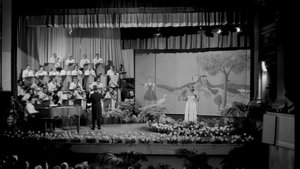
Inspired by the Italian Sanremo Festival, the idea to organise a pan-European musicial competition was born at a meeting of the European Broadcasting Union in Monaco in 1955. It was decided that the first ever Eurovision Song Contest would be hosted the following year in the Swiss resort of Lugano. The 1956 Eurovision Song Contest was primarily a radio show, although some cameras were taping the contest for the few Europeans who had a television set at that time. Lohengrin Filipello hosted the programme, which lasted 1 hour and 40 minutes. The seven participating countries each submitted two entries. The songs of the contest were not to exceed three and a half minutes, and the performers were accompanied by an orchestra of 24 musicians, led by Fernando Paggi.

S6 Ep1
4.3
18th Mar 1961
Just like in 1959, the Palais des Festivals was the venue of this year's contest. The presenter of the show was Jacqueline Joubert, who already did this task in 1959. The stage used for the show was much bigger than in previous years, and it was magnificently decorated with flowers. The number of participants of this year’s song contest rose to 16 as Spain, Yugoslavia and Finland all made their respective debuts. For the first time, the contest took place on a Saturday night which would come to be the contest's home.

S2 Ep1
4.3
3rd Mar 1957
The 1957 Eurovision Song Contest was hosted by the Hessischer Rundfunk on behalf of Deutsches Fernsehen ARD. Austria, Denmark and the United Kingdom entered the contest for the first time, joining the other seven participating countries from the previous year. Despite the fact that an increasing number of Europeans had access to television, the contest was still mainly a radio programme at this time. In a change to the contest the year before, duos were allowed into the competition. Danish duo Birthe Wilke and Gustav Winckler shocked the audience with their passionate on-screen kiss, the longest in the history of the contest. Germany's entry, performed by Margot Hielscher featured a telephone during the performance, the first gimmick to appear at the Eurovision Song Contest.

S3 Ep1
4.3
12th Mar 1958
The Dutch entry Net Als Toen by Corry Brokken had brought the first victory to the Netherlands in Frankfurt am Main the previous year and Dutch TV was the proud host in 1958. It was the first time that the winning country from the previous year had hosted the contest. Despite ending third, the Italian entry Nel Blu Dipinto Di Blu, better known under the title Volare, performed by Domenico Modugno, became a worldwide hit and to date. It is one of the most successful songs in the history of the Eurovision Song Contest. Domenico even managed to reach the No.1 spot in the US-American Billboard Charts with his song and was also awarded three Grammies.

S7 Ep1
4.3
18th Mar 1962
After the victory in Cannes in 1961, Luxembourg was the host of the seventh Eurovision Song Contest. The stage was decorated with twinkling stars, but unfortunately they could not be seen for parts of the evening because there were some problems with the lights in the big auditorium of the Villa Louvigny. The number of participants of this year's contest remained stable at 16 with no new countries entering. However, there was a change in the voting system: the national juries - which still consisted of 10 people - had to attribute 3, 2 and 1 points to their three favourite songs.

S34 Ep1
4.3
6th May 1989
Switzerland hosted the contest for the first time since the inaugural event in 1956. The show was opened by the previous year's winner, Céline Dion. She performed a reprise of her winning song, "Ne Partez Pas Sans Moi," and her new English single, "Where Does My Heart Beat Now," which became her first major hit in the United States. Italy sent its recent San Remo festival winners, Fausto Leali and Anna Oxa. The entries for both Germany and Austria were composed by German pop titan Dieter Bohlen, famous as part of the 1980s duo Modern Talking. A linguistic milestone was set by the host country's entry. The song "Viver Senza Tei" by the group Furbaz was the first ever to be sung in Romansch, one of Switzerland's four official languages.

S46 Ep1
4.5
12th May 2001
23 countries participated in the 2001 Eurovision Song Contest. Bosnia & Herzegovina, Poland, Portugal, Slovenia, Lithuania and Greece all returned to the contest, replacing the seven countries with the lowest average result in the past five contests: Romania, Switzerland, FYR Macedonia, Finland, Belgium, Austria and Cyprus. The spectator record from the previous year in Stockholm was already broken in 2001 as nearly 35,000 attended the show in the Parken Stadium in Copenhagen. France, Greece and Slovenia were predicted to win this year but Estonia took everyone by surprise by taking the trophy.

S18 Ep1
4.7
7th Apr 1973
For the third time in the 18-year-old history of the Eurovision Song Contest, Luxembourg had the honour of hosting the event with 17 nations present. After ending up in last position two years in a row, Malta decided to withdraw from the contest. Austria decided not to participate either. Instead, a new country joined the song contest, Israel. It was the first non-European country to enter the contest. Israel was allowed to do so because the country was already a member of the European Broadcasting Union. With the Israelis participating, the security control was unusually tight and special security measures were put in place for the Israeli delegation. Another important rule change for the 1973 Eurovision Song Contest was that the participants could choose the language in which they wanted to sing their songs. This rule remained in place until 1976 before being re-introduced in 1999.

S30 Ep1
4.7
4th May 1985
The city of Gothenburg was chosen by the Swedish broadcaster to be host city to the 1985 Eurovision Song Contest. This year, the Netherlands chose to withdraw from the contest because it collided with the country's national Remembrance Day. Yugoslavia also decided to stay home because of a national holiday. Israel and Greece returned to the contest so the number of participants was 19 again, just as in the previous year. The set in Gothenburg's Scandinavium was very modern and bigger than any venue before. Parts of the set would later be re-used for the Swedish national final, Melodifestivalen, in 1987.

S33 Ep1
4.7
30th Apr 1988
The 1988 Eurovision Song Contest was hosted in Dublin for the third time, 21 countries competed for the trophy. Host broadcaster RTE introduced a modern set, at that point the largest in the history of the contest. Two giant video walls and a computerised scoreboard were also unveiled. At the time, it was a ground breaking production and set the standard for future editions of the contest. Denmark was represented the group Hot Eyes who performed in the contest for the third time. Lead singer Kirsten was heavily pregnant at the time and gave birth just three weeks after the contest.

S5 Ep1
4.8
29th Mar 1960
The capital of the United Kingdom, London, provided the setting for the fifth Eurovision Song Contest. This was despite the fact that the Netherlands actually won the Eurovision Song Contest in Cannes the year before with Een Beetje, performed by Teddy Scholten. Following the victory the Dutch national broadcaster did not want to host the contest again so the honour went to the UK which had finished second the year before.

S47 Ep1
4.8
25th May 2002
Immediately after Estonia won the 2001 Eurovision Song Contest the media began to speculate whether the country would be able to host the competition in 2002, citing a lack of a suitable venue and budgetary concerns. Estonian Television defied the critics though and produced a professional show in Tallinn. 23 countries participated in 2002. Latvia entered the contest after Portugal declined the opportunity to participate. This was a rather peculiar situation, since Latvia ended up winning the whole contest in the end! There was no clear favorite among the 24 countries competing. Sweden, Germany and the host country Estonia were tipped as winners, but it was Marie N (Marija Naumova) who lifted the trophy.

S29 Ep1
5.0
5th May 1984
After having held the contest last in 1973, Luxembourg played the host for the 1984 Eurovision Song Contest. The total number of participants was 19, one country less than in the preceding year as Greece decided not to enter a song. The contest also clashed with Israel's Remembrance Day, so the country wasn't present in Luxembourg either. Ireland returned to the contest though, finishing second. The Irish song was written by former Eurovision winner, Johnny Logan, under his real name Sean Sherrard. The song Terminal 3 was performed by Linda Martin, who later returned to win the Eurovision Song Contest in 1992.

S44 Ep1
5.0
29th May 1999
In 1999, France, Germany, Spain, and the UK became automatic qualifiers as the highest-paying EBU members. Contestants were also free to perform in any language, a rule not seen since the 1970s. In a controversial move, the orchestra became optional, meaning all entries performed to a backing track for the first time. Latvia withdrew late, and after Hungary declined the offer to participate, the final spot went to Portugal. Meanwhile, Finland, Greece, FYR Macedonia, Romania, and Switzerland were unable to compete due to low average scores in previous years. The Cypriot entry, a pre-contest favourite, received only two points. After the show, Croatia was sanctioned for using synthesized backing vocals against the live-vocal rule. As a penalty, they lost 33% of their points, which negatively impacted their five-year average score.

S4 Ep1
5.3
11th Mar 1959
The Eurovision Song Contest of 1959 welcomed the small principality of Monaco. Moreover, the United Kingdom re-entered the contest after one year of absence, and Luxembourg decided not to participate. A new rule was introduced to this fourth Eurovision Song Contest; musical experts were no longer allowed in the national juries, but other than that, the same voting system as in 1957 and 1958 was used.

S20 Ep1
5.3
22nd Mar 1975
A new voting system, still in place today, was implemented in 1975. Juries in each country awarded points to their top 10 songs: 12 to their favourite, 10 to the second, 8 to the third, and then from 7 down to 1. A record 19 countries took part. France and Malta returned to the contest and Turkey made its debut, while Greece withdrew. Norway's Ellen Nikolaysen performed for a rare third consecutive year. Portugal's entry was highly political, as singer Duarte Mendes dedicated his song to the country's peaceful revolution the previous year. Germany’s entry, Ein Lied Kann Eine Brücke Sein performed by Joy Fleming, saw a disappointing 17th place finish. However, the song has since become a major favourite among fans.

S35 Ep1
5.3
5th May 1990
22 countries participated in the 1990 Eurovision Song Contest, the same line up as in 1989. Many of the songs reflected the wider political developments that were taking place in Europe. The Spanish performance was beset by technical problems. First the backing track failed to play, then it started too early. The delegation's conductor completely lost control and the Spanish duo, Azúcar Moreno, left the stage. The second attempt was successful and the duo ended up in fifth place. Eurovision veteran, Serge Gainsbourg, wrote the French entry White And Black Blues performed by Joelle Ursull which finished in second place along with Ireland's song Somewhere in Europe.

S37 Ep1
5.3
2nd May 1992
A new record of participating countries was set in 1992 as the Netherlands returned to the contest and Malta continued to participate. The venue for the show was the MalmöMässan, a large exhibition and conference centre. The stage was in the shape of a Viking ship's bow and the floor design was an adaption of the EBU's Eurovision logo.

S41 Ep1
5.3
18th May 1996
In 1996, the EBU replaced its relegation system with an audio pre-selection. Juries listened to recordings from 29 countries to choose 22 finalists to join host Norway. Germany, Russia, Denmark, Hungary, Israel, Romania, and FYR Macedonia all failed to qualify for the final in Oslo. The contest was groundbreaking, with host broadcaster NRK using virtual reality in the voting and digital filters during some performances. Each participant also received a televised good luck message from a political figure from their country, ranging from junior ministers to presidents. The show was briefly threatened by a conductor's strike after NRK planned to cut their on-screen appearances to save time, though the dispute was settled amicably. The hosts were Morten Harket, lead singer of A-ha, and journalist Ingvild Bryn.

S43 Ep1
5.3
9th May 1998
In the 1998 Eurovision Song Contest, 25 countries competed. FYR Macedonia made its debut, and nations relegated in 1997 returned. However, Italian broadcaster RAI withdrew from the contest indefinitely. This year marked the first large-scale use of televoting, with national juries only used in countries that lacked a fully functional telephone system. A notable glitch occurred with the Spanish televote; their 12 points, intended for Germany, were mistakenly announced for Israel during the broadcast. The error was corrected shortly after the show. It was a taboo-breaking contest, highlighted by the performance of Israel's Dana International, a transsexual woman, who sang "Diva". Germany also sent an unconventional act, Guido Horn, who famously climbed all over the stage equipment during his wild performance. Due to low five-year average scores, Austria, Bosnia & Herzegovina, Denmark, Russia, and Iceland were relegated and did not compete the following year.

S49 Ep1
5.3
12th May 2004
In 2003, it was decided that a Semi-Final would be held in 2004 with only the so-called 'Big Four' (Germany, UK, France and Spain) plus the ten most successful countries from the 2003 ranking having a place in the Final. Ten remaining countries would qualify from the Semi-Final, which was held on the Wednesday prior to the Eurovision Song Contest Final night on Saturday. 22 countries decided to took part in the 2004 Semi-Final, all countries used telephone and SMS voting. Several new countries entered in 2004; Andorra, Albania and Belarus along with Serbia & Montenegro. Monaco returned to the contest after a 25-year absence.

S39 Ep1
5.4
30th Apr 1994
In 1994 seven countries joined the Eurovision Song Contest in what was the biggest single expansion in participants since the contest began in 1956. Estonia, Hungary, Lithuania, Poland, Romania, Russia and Slovakia all competed in the 39th Eurovision Song Contest in Dublin. Poland's debut at the Eurovision Song Contest was very successful when their representative Edyta Gorniak finished second with 166 points. The interval act in 1994 was the then unknown Riverdance, an act which combined traditional Irish folk music with modern dance. Riverdance became a global phenomenon, with the exception of participating artists, it is arguably the biggest money-spinner ever created by Eurovision. Lithuania scored zero points with its first ever entry.

S51 Ep2
5.4
20th May 2006
Carola, who won the Eurovision Song Contest for Sweden in 1991 and finished third in 1983, returned to the contest with her song Invincible, was widely tipped to do well. Another hotly tipped winner was Russian singer Dima Bilan with his song Never Let You Go. German group Texas Lightning did well in at the bookmakers with their refreshing pop-country song No No Never, but the song only managed a disappointing 14th place. Anna Vissi, the Greek pop queen who had already participated in the song contest in 1980 and 1982, had high hopes to win the competition with her dramatic performance of Everything.

S1 Ep1
3.3
24th May 1956
Inspired by the Italian Sanremo Festival, the idea to organise a pan-European musicial competition was born at a meeting of the European Broadcasting Union in Monaco in 1955. It was decided that the first ever Eurovision Song Contest would be hosted the following year in the Swiss resort of Lugano. The 1956 Eurovision Song Contest was primarily a radio show, although some cameras were taping the contest for the few Europeans who had a television set at that time. Lohengrin Filipello hosted the programme, which lasted 1 hour and 40 minutes. The seven participating countries each submitted two entries. The songs of the contest were not to exceed three and a half minutes, and the performers were accompanied by an orchestra of 24 musicians, led by Fernando Paggi.
Loading...
The first episode of Eurovision Song Contest aired on May 24, 1956.
The last episode of Eurovision Song Contest aired on May 17, 2025.
There are 110 episodes of Eurovision Song Contest.
There are 70 seasons of Eurovision Song Contest.
Yes.
Eurovision Song Contest is set to return for future episodes.